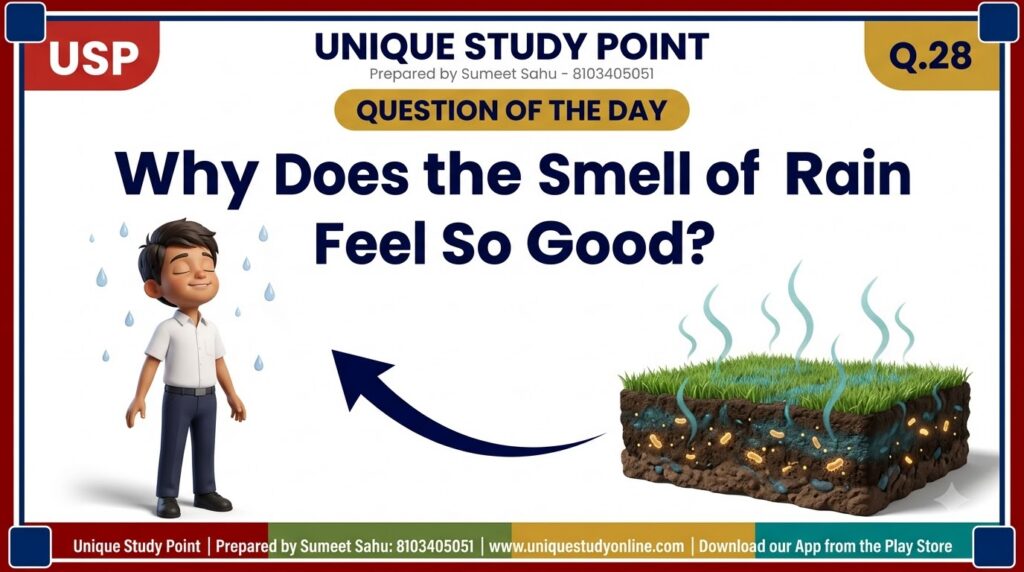
Why does the smell of rain feel so good? That distinctive smell is called petrichor — made up of geosmin from soil bacteria, oils released by plants, and ozone from lightning. This 400 million year old chemical signal is processed by your brain as a survival cue. In this post, we explain exactly why does the smell of rain feel so good, what petrichor is made of, and why humans are extraordinarily sensitive to it.
You know exactly what it smells like. That moment just before the rain arrives — or the first few minutes after it touches the dry earth. Something in the air changes. You stop, close your eyes, and breathe it in deeply. It feels ancient, peaceful, deeply satisfying. Scientists have a name for it. And the reason it feels so powerful goes back 400 million years. 👇
The smell of rain is called petrichor — a combination of geosmin (released by soil bacteria), plant oils, and ozone from lightning. Your brain responds so powerfully to it because for 400 million years, this smell has signalled the presence of water — the most essential thing for survival.
What is petrichor — and where does the word come from?
The word petrichor was coined in 1964 by two Australian scientists, Isabel Bear and R. G. Thomas. They combined two Greek words: petra (stone) and ichor (the fluid that flows through the veins of the gods in Greek mythology). Stone-blood. The fluid of the earth.
It is one of the most poetic names in all of science — and the smell itself has been part of life on Earth for far longer than humans have existed.
The three chemicals that make the smell
| Chemical | Source | What it smells like |
|---|---|---|
| Geosmin | Actinomycetes bacteria in soil | Earthy, deep, warm — the main petrichor note |
| Plant oils | Oils released by plants during dry periods, absorbed by rocks and soil | Fresh, green, slightly woody |
| Ozone (O₃) | Lightning splits oxygen molecules; wind carries it ahead of the storm | Sharp, clean, electric — “smell of rain coming” |
Each of these three chemicals contributes a different layer to the smell. Together, they create the complex, multi-layered fragrance that humans find so deeply satisfying.
Geosmin — the main hero of petrichor
The dominant note in petrichor is geosmin — produced by a type of soil bacteria called actinomycetes. These bacteria live in the top layer of soil and produce geosmin as part of their life cycle — particularly when conditions are dry and the bacteria are forming spores.
When rain hits dry soil, it creates tiny air bubbles that burst — releasing geosmin into the air in microscopic droplets. This process is called aerosol generation — and it is why the smell is strongest immediately after rain hits dry earth, not during continuous rainfall.
Why does your nose detect it so powerfully?
Human beings are extraordinarily sensitive to geosmin — far more than to almost any other chemical:
| Chemical | Detection threshold |
|---|---|
| Geosmin (petrichor) | 5 parts per trillion — one of the lowest thresholds known |
| Ethanol (alcohol) | ~100 parts per million |
| Hydrogen sulfide (rotten eggs) | ~0.5 parts per billion |
| Vanilla | ~200 parts per billion |
Your nose can detect geosmin at concentrations millions of times lower than most other smells. This extreme sensitivity is not an accident — it is the result of millions of years of evolution.
Why does it feel emotionally good — the evolutionary answer
For most of human history — and for millions of years before humans existed — water was the single most critical resource for survival. The smell of rain meant water was coming. Water meant life.
Over hundreds of millions of years, animals that were attracted to the smell of rain — and moved toward it — survived and reproduced more successfully. Those that ignored it were more likely to die of thirst. The result: your brain today has a deeply wired positive response to petrichor. It is not just pleasant — it is a survival signal from your evolutionary past.
400 million years ago, bacteria made geosmin.
Rain carried it to your ancestors.
Your ancestors followed it to water — and survived.
Today, you just close your eyes and breathe it in. 🌧️
Why does it smell stronger before rain than during?
The smell before rain is mostly ozone — carried ahead of a storm by the downdraft winds. It has that sharp, electric, “rain is coming” quality. The smell after rain hits dry earth is geosmin and plant oils released from the soil. Continuous rain actually washes away the chemicals — so the strongest petrichor is always in the first few minutes after rain hits dry ground.
🌟 DID YOU KNOW?
Human noses detect geosmin at just 5 parts per trillion — making us more sensitive to this smell than sharks are to blood in water. Sharks can detect blood at about 1 part per billion — a thousand times less sensitive than humans detecting petrichor. Scientists believe this extreme sensitivity evolved because finding water was far more critical to survival than almost anything else — and petrichor was one of the most reliable signals that water was near.
Tum exactly jaante ho yeh smell kaisi hoti hai. Woh pal jab baarish aane wali hoti hai — ya pehli baarish ke kuch minute baad jab woh sukhi dharti se takraati hai. Hawa mein kuch badal jaata hai. Ruk jaate ho, aankhein band karte ho, aur gehri saanch lete ho. Kuch ancient, peaceful, deeply satisfying lagta hai. Scientists ke paas iske liye ek naam hai. Aur yeh itni powerful kyun lagti hai — iska jawab 400 million saal puraana hai. 👇
Baarish ki smell ko petrichor kehte hain — geosmin (soil bacteria se), plant oils, aur bijli se bane ozone ka combination. Tumhara brain ise itna powerfully respond karta hai kyunki 400 million saalon se yeh smell paani ki presence signal karti rahi hai — survival ke liye sabse zaroori cheez.
Petrichor kya hai — aur yeh naam kahan se aaya?
Yeh word petrichor 1964 mein do Australian scientists — Isabel Bear aur R. G. Thomas — ne coin kiya. Unhone do Greek words mile: petra (pathar) aur ichor (Greek mythology mein devtaon ki rag mein bahne wala fluid). Pathar ka khoon. Dharti ka fluid.
Science mein sabse poetic names mein se ek — aur yeh smell khud Earth par life se kahin zyada purani hai.
Teen chemicals jo yeh smell banate hain
| Chemical | Source | Kaisi smell hai |
|---|---|---|
| Geosmin | Mitti mein actinomycetes bacteria | Earthy, gehri, warm — petrichor ka main note |
| Plant oils | Sukhe dino mein plants ke oils, pathar aur mitti mein absorb | Fresh, green, thodi woody |
| Ozone (O₃) | Bijli oxygen molecules split karti hai; hawa aage le jaati hai | Sharp, clean, electric — “baarish aa rahi hai” wali smell |
Teeno chemicals petrichor mein alag alag layers contribute karti hain. Milke woh complex, multi-layered fragrance create karte hain jo humans ko itni satisfying lagti hai.
Geosmin — petrichor ka main hero
Petrichor ka dominant note hai geosmin — ek type ke soil bacteria actinomycetes se produce hota hai. Yeh bacteria mitti ki top layer mein rehte hain aur geosmin apne life cycle ke hisse ke roop mein produce karte hain — khaaskar jab conditions sukhi hon aur bacteria spores bana rahe hon.
Jab baarish sukhi mitti se takraati hai, tiny air bubbles create hote hain jo burst karte hain — geosmin ko microscopic droplets mein hawa mein release karte hain. Yeh process aerosol generation kehlata hai — isliye smell sabse zyada strong hoti hai jab baarish sukhi dharti se pehli baar takraati hai, lagaataar baarish mein nahi.
Tumhari naak ise itna powerfully kyun detect karti hai?
Insaan geosmin ke liye extraordinary sensitive hain — almost kisi bhi doosre chemical se kahin zyada:
| Chemical | Detection threshold |
|---|---|
| Geosmin (petrichor) | 5 parts per trillion — sabse low thresholds mein se ek |
| Ethanol (alcohol) | ~100 parts per million |
| Hydrogen sulfide (sade ande) | ~0.5 parts per billion |
| Vanilla | ~200 parts per billion |
Tumhari naak geosmin ko concentrations par detect kar sakti hai jo zyaadatar doosri smells se millions of times kam hai. Yeh extreme sensitivity accident nahi hai — yeh millions of years ke evolution ka result hai.
Yeh emotionally achhi kyun lagti hai — evolutionary answer
Insaan ke zyaadatar history mein — aur humans ke exist hone se kahin pehle millions of saalon mein — paani survival ke liye sabse critical resource tha. Baarish ki smell matlab paani aa raha hai. Paani matlab zindagi.
Hundreds of millions of saalon mein, woh janwar jo baarish ki smell ki taraf attract hote the — aur us taraf jaate the — zyada successfully survive karte the aur reproduce karte the. Jo ignore karte the dehydration se marne ke zyada chances lete. Result: tumhara brain aaj petrichor ke liye deeply wired positive response rakhta hai. Sirf pleasant nahi — yeh tumhare evolutionary past ka survival signal hai.
400 million saal pehle, bacteria ne geosmin banaya.
Baarish use tumhare purvaj tak le gayi.
Tumhare purvaj iske peechhe paani dhundhne gaye — aur bach gaye.
Aaj, tum bas aankhein band karte ho aur saanch lete ho. 🌧️
Baarish se pehle smell zyada strong kyun hoti hai?
Baarish se pehle ki smell mostly ozone hoti hai — toofan ke aage downdraft winds se carry hoti hai. Usmein woh sharp, electric, “baarish aa rahi hai” quality hoti hai. Baarish ke sukhi dharti se takraane ke baad ki smell geosmin aur plant oils hoti hai mitti se release hoti hain. Lagaataar baarish actually chemicals wash kar deti hai — isliye sabse strong petrichor hamesha pehle kuch minute mein hoti hai jab baarish sukhi zameen se takraati hai.
🌟 DID YOU KNOW?
Insaan ki naak geosmin sirf 5 parts per trillion par detect kar leti hai — humein sharks se zyada sensitive banata hai paani mein khoon detect karne mein. Sharks khoon karib 1 part per billion par detect kar sakte hain — petrichor detect karne mein humans se hazaar guna kam sensitive. Scientists maante hain yeh extreme sensitivity isliye evolve hui kyunki paani dhundhna survival ke liye almost kisi bhi doosri cheez se kahin zyada critical tha — aur petrichor ek sabse reliable signal tha ki paani paas mein hai.